
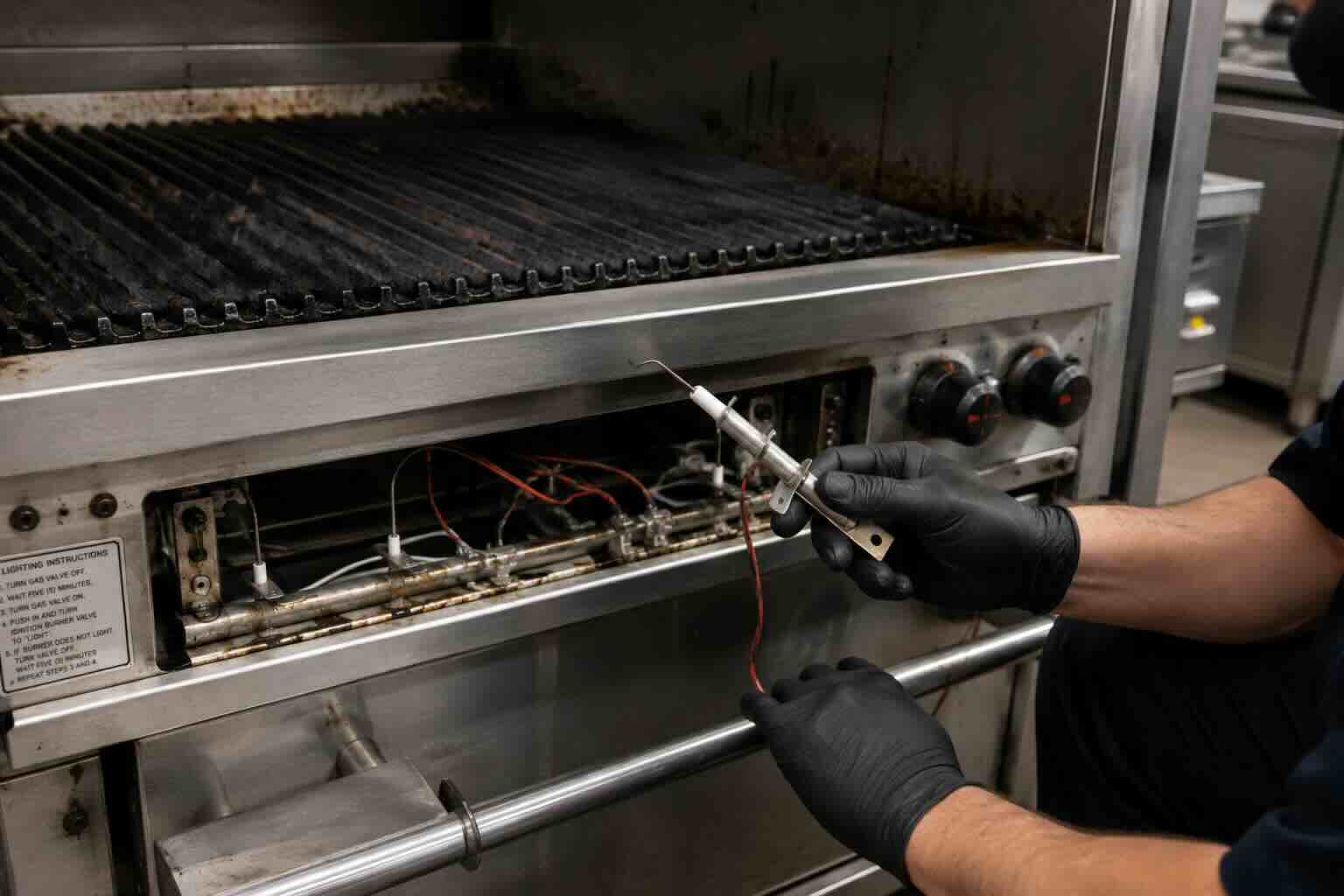
A commercial charbroiler that will not light can immediately slow down a restaurant’s cooking line. The problem may affect one burner, several cooking zones, or the entire appliance.
The most common causes include an extinguished or weak pilot flame, blocked burner ports, restricted gas flow, a defective thermocouple or safety valve, and an electronic ignition failure. The pattern of the failure usually provides the first diagnostic clue.
Because charbroilers use gas and operate at high temperatures, restaurant staff should limit troubleshooting to basic observations. Gas pressure adjustments, pilot repairs, burner disassembly, and safety-control testing require a qualified commercial equipment technician.
QUICK DIAGNOSIS BY SYMPTOM
| What the charbroiler is doing | Possible cause |
| No burners will light | Main gas supply, regulator, shared ignition system, or building gas problem |
| Only one burner will not light | Individual pilot, blocked burner ports, gas orifice, or burner valve |
| Pilot lights but will not stay on | Weak pilot flame, thermocouple, or pilot safety valve |
| Pilot stays lit but burner does not ignite | Burner blockage, incorrect pilot position, or burner valve problem |
| Ignition is delayed or produces a “whoosh” | Weak pilot, accumulated gas, blocked burner, or pressure problem |
| Burner lights but flame is weak or uneven | Restricted ports, incorrect gas pressure, or airflow problem |
| Electronic ignition clicks but no flame appears | Spark electrode, ignition module, wiring, gas supply, or flame sensor |
This table can help staff describe the problem, but it cannot replace proper diagnosis. Several different component failures can produce similar symptoms.
FIRST: WHAT TO DO IF YOU SMELL GAS
Do not attempt to relight the charbroiler when there is a gas odor, hissing sound, gas-detector alarm, or other indication of a possible leak.
Leave the area immediately and take employees and customers with you. Do not operate switches, appliances, phones, or anything that could produce a spark. Call 911 or the appropriate gas utility only after reaching a safe location. Con Edison gives the same instructions for suspected gas leaks in New York.
Do not return until emergency personnel or the gas utility confirms that the premises are safe.
1. THE PILOT FLAME IS OUT OR TOO WEAK
Many commercial charbroilers use a separate standing pilot for each burner. This allows one section to continue working even when another section develops an ignition problem.
A pilot may go out because of:
- a temporary interruption in the gas supply;
- grease or debris around the pilot;
- a restricted pilot opening;
- insufficient gas pressure;
- unstable airflow;
- a defective pilot component.
A weak pilot may remain visible but fail to ignite the main burner. Staff may notice that the burner lights only after several attempts or that the pilot goes out when another cooking zone is activated.
Vulcan’s charbroiler documentation confirms that some models use one pilot for every burner. The manufacturer identifies low pilot flame, a restricted pilot orifice, and low gas pressure as possible causes of pilot failure.
A pilot that repeatedly goes out should not simply be relit throughout the shift. The underlying airflow, gas-flow, or safety-control problem must be identified.
2. GREASE OR DEBRIS IS RESTRICTING THE BURNER
Commercial charbroilers operate directly below food, grease, marinades, crumbs, and carbonized residue. Over time, contamination can restrict the burner ports or interfere with the path between the pilot flame and the burner.
Possible signs include:
- one burner refusing to light;
- delayed ignition;
- an incomplete flame pattern;
- weak heat in one section;
- popping sounds;
- yellow or unstable flames.
Removable grates, radiants, deflector trays, and crumb trays should be cleaned at the intervals specified by the manufacturer. These components must also be returned to their correct positions after cleaning.
Staff should not push needles, wires, drill bits, or metal tools into burner ports or gas orifices. These openings are manufactured to control a specific amount of gas. Enlarging or damaging them can alter combustion and create an unsafe flame condition.
3. GAS IS NOT REACHING THE BURNER CORRECTLY
When no burners will light, the problem may involve the appliance’s main gas supply rather than an individual burner.
Possible causes include:
- interruption of the building gas supply;
- an upstream shutoff condition;
- an incorrectly operating pressure regulator;
- a restricted gas line;
- insufficient gas pressure;
- excessive demand from other kitchen equipment.
If several gas appliances stopped working at the same time, restaurant management should contact the building manager, facilities department, gas utility, or an appropriately qualified technician.
If only one burner is affected, the problem may be an individual burner valve or gas orifice.
Commercial charbroilers must be connected to the fuel type shown on the equipment data plate and installed with the appropriate gas controls and regulator. Pressure testing and regulator adjustment require proper instruments and should not be performed by restaurant staff.
4. THE THERMOCOUPLE OR PILOT SAFETY VALVE HAS FAILED
Some charbroilers use a thermocouple to confirm that the pilot flame is present. When the pilot heats the thermocouple, the component sends a small signal that allows the safety valve to remain open.
If the thermocouple does not generate the required signal, the gas supply to the pilot may shut off.
A typical symptom is a pilot that remains lit only while the pilot control or safety button is held. As soon as the control is released, the flame goes out.
Possible causes include:
- the pilot flame not reaching the thermocouple;
- incorrect thermocouple position;
- grease or carbon around the sensing area;
- a loose connection;
- thermocouple deterioration;
- failure of the pilot safety valve.
Manufacturer troubleshooting information for commercial gas equipment identifies a safety-valve problem or a thermocouple that is not positioned in the pilot flame as possible causes when a pilot will not remain lit.
These components form part of the charbroiler’s gas safety system. They should never be bypassed or held open as a temporary operating solution.
5. THE ELECTRONIC IGNITION SYSTEM IS NOT PRODUCING A USABLE SPARK
Some commercial charbroilers use electronic ignition rather than a manually lit standing pilot.
The system may include:
- a spark electrode;
- ignition wire;
- ignition module;
- transformer;
- flame sensor;
- gas valve;
- electrical safety controls.
The presence of a clicking sound does not confirm that the ignition system is functioning correctly. The spark must occur at the correct location, the burner must receive gas, and the control must detect the resulting flame.
Common symptoms include:
- no clicking or sparking;
- clicking without ignition;
- intermittent ignition;
- a burner that lights and then shuts off;
- ignition-related error codes;
- a visible spark occurring away from the pilot or burner.
Restaurant staff can record the sound, timing, and displayed error code. They should not remove electrical panels, reposition electrodes, or test ignition wiring.
6. THE BURNER FLAME OR AIRFLOW IS UNSTABLE
A burner that lights but does not remain stable may have an incorrect gas-to-air mixture, restricted burner ports, unsuitable pressure, or damaged internal components.
Watch for:
- large yellow flames;
- flames lifting away from the burner;
- soot;
- weak or incomplete flames;
- unusually loud burner operation;
- inconsistent heat across the cooking surface.
A stable commercial charbroiler pilot should remain lit and ignite its burner without a delay. Vulcan’s service guidance uses reliable pilot operation and immediate burner ignition as indicators of correct adjustment.
The restaurant’s ventilation system can also affect operating conditions. The charbroiler must be installed under suitable ventilation, and the area between the appliance and hood should remain unobstructed. However, air-shutter adjustments and combustion testing should be left to trained technicians.
WHAT RESTAURANT STAFF CAN SAFELY CHECK
When there is no gas odor or emergency condition, staff can document several basic details before requesting service:
- Determine whether one burner or every burner is affected.
- Check whether other gas appliances are operating normally.
- Record whether the unit uses standing pilots or electronic ignition.
- Note whether the pilot is visible and whether it remains lit.
- Listen for clicking, popping, grinding, or unusual burner sounds.
- Record any error code.
- Confirm that removable grates, radiants, and trays were correctly reinstalled after cleaning.
- Check for visible grease or food accumulation after the equipment has cooled.
- Locate the model and serial number.
- Stop using any section with delayed ignition, unstable flames, or damaged infrared components.
Follow only the lighting procedure given in the operator manual for the exact charbroiler model. When the prescribed procedure does not work, stop and request service rather than improvising.
WHEN TO REMOVE THE CHARBROILER FROM SERVICE
Stop using the affected equipment when:
- gas can be smelled;
- ignition is delayed;
- the burner lights with a sudden “whoosh”;
- the pilot repeatedly goes out;
- flames are yellow, lifting, or unstable;
- soot appears around the burner area;
- a control valve sticks;
- an infrared burner is cracked or visibly damaged;
- an electrical breaker repeatedly trips;
- the equipment must be relit several times during one shift.
Delayed ignition is particularly important. It may allow unburned gas to accumulate before the burner ignites. Repeated attempts do not correct the underlying problem and can increase the risk.
FREQUENTLY ASKED QUESTIONS
WHY WILL ONLY ONE CHARBROILER BURNER NOT LIGHT?
When the remaining burners operate correctly, the problem is usually limited to the affected zone. Common causes include an individual pilot problem, blocked burner ports, a damaged gas orifice, or a defective burner valve.
WHY DOES THE PILOT LIGHT BUT GO OUT WHEN I RELEASE THE CONTROL?
The pilot flame may not be heating the thermocouple correctly, or the thermocouple or safety valve may have failed. Do not hold or bypass the control to keep gas flowing. The pilot safety system requires professional inspection.
CAN GREASE CAUSE A COMMERCIAL CHARBROILER NOT TO LIGHT?
Yes. Grease and carbon deposits can restrict burner ports, interfere with pilot operation, and affect airflow. Staff may clean removable operator-serviceable components after the appliance has cooled, but internal pilot and burner components should not be dismantled without proper training.
WHY DOES THE CHARBROILER CLICK BUT NOT IGNITE?
The electronic ignition system may be creating a spark without producing ignition. Possible causes include a misaligned electrode, defective ignition wire, failed module, interrupted gas supply, blocked burner, or flame-sensor problem.
HOW MUCH DOES COMMERCIAL CHARBROILER REPAIR COST?
The price depends on the charbroiler type, failed component, equipment access, required parts, and extent of the diagnostic work. A blocked pilot, failed thermocouple, defective burner valve, and electronic ignition failure require different repairs. An accurate estimate requires inspection of the appliance.
COMMERCIAL CHARBROILER REPAIR IN NYC
A commercial charbroiler that will not light may have an isolated pilot or burner problem, but the same symptom can also indicate a gas-supply, safety-control, or electronic ignition failure.
Screws Appliance Repair services radiant, infrared, lava rock, countertop, and floor-model commercial charbroilers used in New York City restaurant kitchens. The service includes diagnosis of pilot problems, burner failures, uneven heat, airflow issues, and ignition faults, with same-day service available when scheduling permits.
If a pilot will not stay lit, a burner fails to ignite, or ignition is delayed, remove the affected section from service and schedule a professional inspection.