A commercial refrigerator does not maintain one exact air temperature every second of the day. The displayed reading may rise when the compressor stops, during a defrost cycle, after the door is opened, or when the cabinet is loaded with warmer products. It should then return to its normal operating range.
The problem begins when temperatures rise too far, take too long to recover, vary significantly between shelves, or affect the actual temperature of stored food. These patterns may indicate restricted airflow, a damaged door gasket, dirty condenser coils, evaporator icing, a fan failure, an inaccurate sensor, or a developing refrigeration-system problem.
Before adjusting the thermostat or requesting service, restaurant staff should determine whether they are seeing normal air-temperature cycling or a genuine commercial refrigerator temperature fluctuation affecting the product.
Is the temperature change normal or a sign of failure?
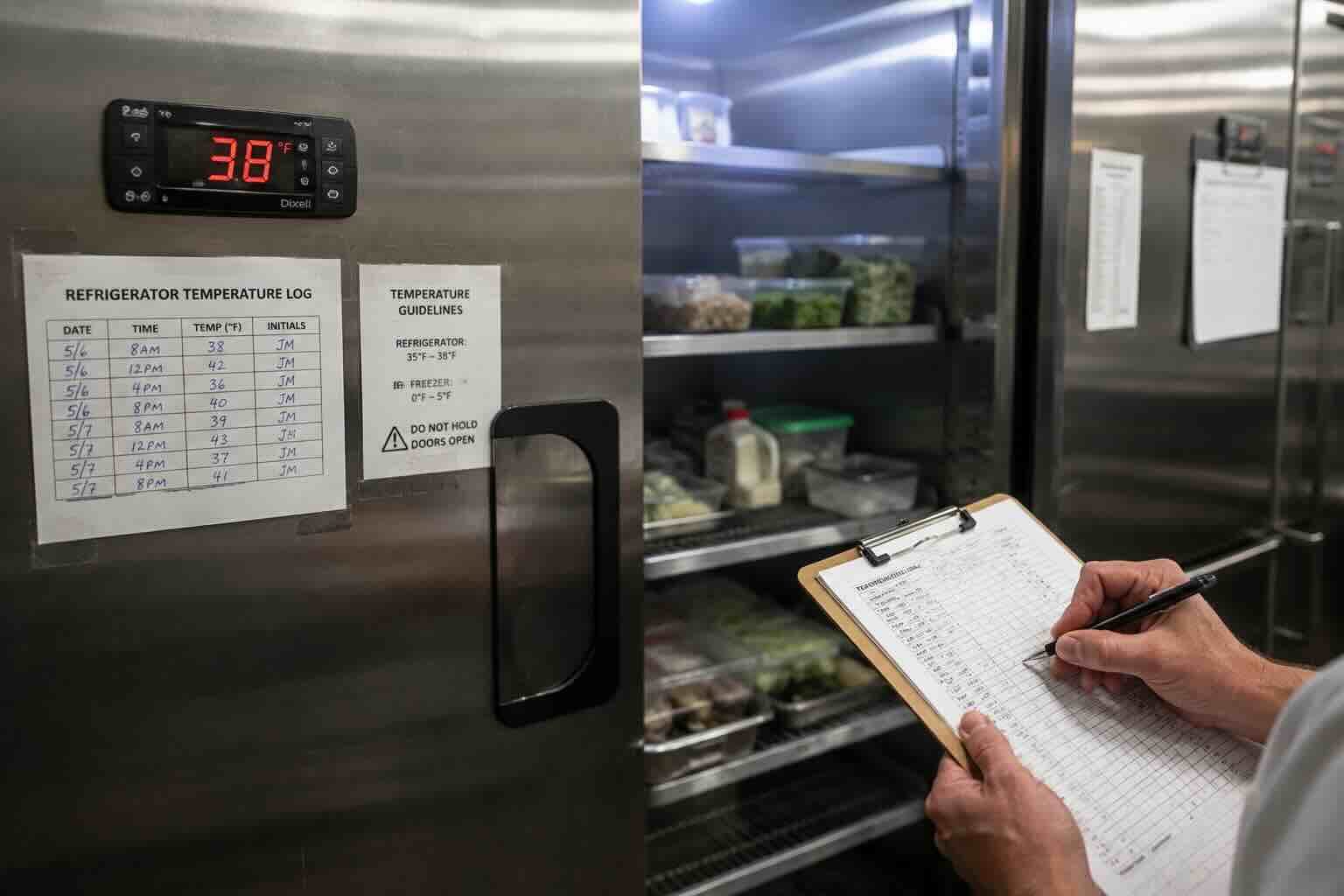
Commercial refrigerator displays commonly measure air temperature or evaporator-coil temperature rather than the temperature of the stored product. Because the compressor cycles on and off, the displayed number may move up and down even while the food remains within the correct range.
TRUE Manufacturing specifically notes that analog thermometers, digital thermometers, and electronic displays can reflect normal refrigeration-cycle swings rather than product temperature. The manufacturer recommends checking product temperature when evaluating actual refrigerator performance.
Use the pattern of the fluctuation to determine whether further investigation is required.
| Temperature pattern | Possible explanation |
| Display rises briefly and returns to normal | Compressor cycle, door opening, or defrost cycle |
| Display changes but product temperature remains stable | Normal air-temperature fluctuation |
| Temperature rises every time the kitchen becomes busy | Frequent door opening, high ambient heat, or heavy loading |
| One shelf is warm while another is too cold | Restricted internal airflow |
| Entire cabinet warms and recovers slowly | Door, condenser, fan, control, or refrigeration problem |
| Temperature repeatedly falls too low and then rises sharply | Sensor, thermostat, control, or airflow problem |
| Temperature continues rising while the compressor runs | Condenser, evaporator, fan, refrigerant, or compressor fault |
Many commercial reach-in refrigerators are engineered to maintain cabinet temperatures around 33°F to 38°F, although the correct operating range depends on the manufacturer and model. NYC requirements state that applicable time- and temperature-controlled food must generally be held at or below 41°F.
Check the product temperature before changing the controls
Repeatedly adjusting the thermostat based only on the display can make the problem more difficult to diagnose. The control may be responding normally to changes in air or coil temperature.
A more reliable check should include:
- Record the refrigerator display temperature.
- Measure the temperature of stored products with a properly calibrated food thermometer.
- Compare products from the center, upper, lower, front, and rear sections.
- Note whether the doors were recently opened or products were recently loaded.
- Repeat the measurements over a complete operating period.
- Record any error codes, ice buildup, unusual noises, or continuous compressor operation.
TRUE also recommends using a container of water left inside the cooler for 24 hours when checking a stable product-equivalent temperature, rather than relying only on momentary air readings.
If the display changes but product temperatures remain stable, the refrigerator may be operating normally. If stored food is warming, freezing, or showing significant differences between locations, the fluctuation requires investigation.
Door traffic and product loading can overwhelm the refrigerator
Commercial refrigerators in active kitchens are opened far more frequently than residential units. Every door opening allows cold air to escape and warm, humid kitchen air to enter.
A brief rise is expected. Repeated or extended openings can prevent the cabinet from recovering before the next service cycle begins.
Temperature instability may increase when staff:
- leave doors open while restocking;
- load several cases of warmer products at once;
- place hot food directly into a holding refrigerator;
- overfill shelves;
- block the internal air passages;
- push containers against the rear or side walls;
- store products in front of the evaporator fan;
- use incorrectly fitted pans in refrigerated prep tables.
A heavily loaded cabinet may initially appear cold because the display is near the air outlet, while products in areas with poor circulation remain warmer.
TRUE identifies product touching interior walls and insufficient clearance around the evaporator fan as causes of improper airflow and inconsistent product temperatures. Its guidance also notes that incorrect pan placement and double-panning in prep tables can allow warm-air infiltration and make products too warm.
If temperature fluctuations occur mainly during delivery, preparation, or peak service, review how the refrigerator is being loaded and operated before assuming that a component has failed.
Restricted airflow creates hot and cold zones
Cold air must move throughout the entire cabinet. When circulation is restricted, the refrigerator may develop several temperature zones instead of one stable storage environment.
Products close to the evaporator outlet may become too cold or partially freeze. Products near the doors, in tightly packed sections, or behind large containers may remain too warm.
Restricted airflow may result from:
- overstocked shelves;
- products touching cabinet walls;
- containers blocking supply or return vents;
- incorrect shelf placement;
- ice on the evaporator;
- a slow or intermittent evaporator fan;
- a damaged fan blade;
- food pans that do not fit correctly;
- interior modifications not approved by the manufacturer.
TRUE lists inconsistent temperatures—with some products too warm and others too cold—as a typical sign of improper internal airflow.
Staff can correct obvious loading problems, but a fan that stops, runs intermittently, or produces scraping and rattling noises requires professional diagnosis.
The door is not sealing consistently
A refrigerator door does not need to remain visibly open to affect temperature. A small gap around the gasket can allow a continuous flow of warm air into the cabinet.
Common causes include:
- a torn, hardened, or distorted gasket;
- grease and food residue on the sealing surface;
- worn hinges;
- a defective self-closing mechanism;
- a misaligned door;
- a unit that is not level;
- containers preventing full closure;
- an overstocked cabinet.
The incoming humidity can also contribute to condensation and evaporator icing, which further reduces cooling performance.
Manufacturer guidance states that door and drawer gaskets must seal properly for correct operation. TRUE identifies defective gaskets, failed self-closing mechanisms, improper leveling, and overstocking as common causes of sealing problems.
Inspect the gasket around its full perimeter. A section that no longer contacts the cabinet evenly can explain why temperatures rise after every opening and recover more slowly throughout the day.
Dirty condenser coils reduce cooling capacity
The condenser releases heat removed from the refrigerator. Grease, dust, flour, and airborne debris can accumulate on the coil, especially in restaurant kitchens.
As the condenser becomes restricted, the refrigeration system must run longer to remove the same amount of heat. The cabinet may still cool during quiet periods but struggle during busy service, warm weather, or heavy loading.
Possible signs include:
- temperatures rising during peak operating hours;
- slow recovery after the doors close;
- continuous compressor operation;
- unusually warm air around the condensing section;
- increasing temperature alarms;
- higher energy consumption;
- eventual refrigeration-system shutdown.
TRUE states that a dirty condenser restricts airflow and prevents the refrigeration system from operating efficiently. The manufacturer also associates inadequate condenser maintenance with evaporator freezing and refrigeration-system failure.
Cleaning requirements vary by model. Staff should follow the applicable manual and should not spray the condenser or electrical section with water. Heavy grease contamination or an inaccessible condenser should be handled by a qualified technician.
Evaporator icing changes airflow and temperature recovery
A thin, controlled frost pattern may occur during normal operation. A heavily iced evaporator is not normal.
Ice blocks airflow through the evaporator coil. The refrigerator may initially become colder in one section while products farther from the coil begin warming. As the blockage increases, the entire cabinet can lose cooling capacity.
Evaporator icing may be connected to:
- a door that does not seal;
- frequent warm-air infiltration;
- blocked internal airflow;
- a failed evaporator fan;
- a drain or defrost problem;
- an inaccurate sensor;
- a control failure;
- a refrigeration-system fault.
Commercial refrigeration systems use defrost events to prevent the evaporator from freezing. If the defrost sequence does not occur correctly, or if warm humid air enters faster than the system can manage, ice may continue accumulating.
Do not remove evaporator ice with knives, screwdrivers, heat guns, or open flame. Sharp tools can puncture the coil, while uncontrolled heat can damage wiring and plastic components.
A fan may be stopping or running intermittently
Commercial refrigerators normally use an evaporator fan to distribute cold air and a condenser fan to remove heat from the refrigeration system.
A failing fan may work when the unit is first started and stop after the motor becomes hot. This can create a repeating pattern: the refrigerator cools normally, the fan stops, temperatures rise, and operation improves again after the motor cools or the unit is restarted.
Warning signs include:
- temperature differences between shelves;
- intermittent airflow;
- unusual rattling, squealing, or scraping;
- a fan that is unusually quiet;
- ice forming around the evaporator;
- a compressor that runs without effective cooling;
- temperature changes linked to door operation.
Evaporator fans may cycle according to compressor operation, door position, or control programming, so the fan is not necessarily defective simply because it is not running at one specific moment. A technician must evaluate its operation against the sequence intended for the exact model.
The temperature sensor or control is inaccurate
The refrigerator may be cooling correctly while the control receives incorrect temperature information. Alternatively, a failed control may switch the compressor on and off at the wrong points.
Possible control-related symptoms include:
- readings changing without a corresponding product-temperature change;
- the refrigerator becoming too warm and then too cold;
- frequent short cycling;
- long periods between cooling cycles;
- a compressor that does not stop;
- inaccurate high- or low-temperature alarms;
- sensor or control error codes.
A sensor can become inaccurate because of component deterioration, damaged wiring, moisture, ice, incorrect placement, or a loose connection.
Commercial refrigeration controls use programmed cut-in, cut-out, setpoint, and differential temperatures to determine when the compressor operates. These settings are specific to the equipment design and should not be changed without the correct service information.
When airflow, loading, doors, fans, and condenser condition are normal but product temperatures remain unstable, professional testing of the sensor and control system is required.
The refrigeration system is losing capacity
Temperature fluctuation may be an early sign of a more significant refrigeration failure.
Possible causes include:
- a refrigerant leak;
- a restricted refrigerant circuit;
- compressor wear;
- a failing start component;
- condenser fan failure;
- an incorrectly operating expansion device;
- damaged refrigeration tubing.
The refrigerator may initially maintain temperature overnight but fail during daytime service. As the fault progresses, recovery periods become longer and the compressor may run almost continuously.
These problems cannot be diagnosed from cabinet temperature alone. Refrigerant pressures, electrical readings, coil condition, airflow, and compressor performance must be evaluated together.
Restaurant staff should not open the sealed refrigeration system or attempt to add refrigerant. A low refrigerant charge usually indicates a leak that must be located and repaired rather than temporarily refilled.
When temperature fluctuation requires immediate action
Arrange professional service when:
- product temperature exceeds the required holding limit;
- the cabinet does not recover after the doors are closed;
- temperatures differ significantly between shelves;
- products begin freezing in a refrigerator;
- the compressor runs continuously;
- the equipment starts and stops every few minutes;
- the evaporator is covered with ice;
- a fan stops or becomes noisy;
- the door will not seal;
- an error code or temperature alarm appears;
- the refrigerator loses power intermittently;
- the problem becomes worse during each service period.
NYC Health Code generally requires applicable cold TCS food to be held at or below 41°F. Restaurants must use appropriate temperature-measuring devices and should follow their established food-safety procedure when products are found outside the required range.
Do not rely only on the cabinet display when deciding whether food remains safe. Measure the actual product temperature and document the time, reading, and corrective action.
How to reduce future temperature instability
A practical refrigerator-monitoring routine should include:
- checking and recording product temperatures;
- keeping the cabinet within its intended capacity;
- maintaining clearance around air vents;
- closing doors promptly;
- inspecting gaskets and hinges;
- reporting unusual fan or compressor noise;
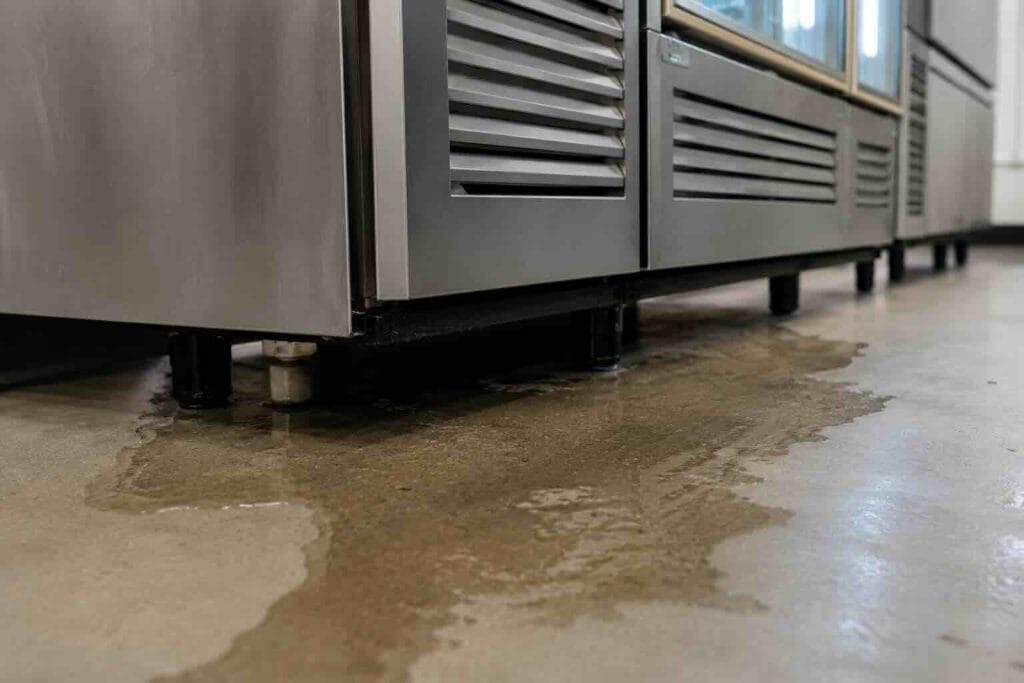
- checking for water and evaporator ice;
- maintaining condenser coils according to the manufacturer’s schedule;
- recording repeated alarms and temperature changes;
- scheduling service before the unit stops maintaining temperature completely.
Temperature logs are more useful when they include the time, product location, door activity, and operating conditions. A single reading once per day may not reveal a problem that occurs only during deliveries or peak kitchen hours.
Frequently asked questions
Why does my commercial refrigerator temperature rise and then fall?
A limited rise and fall may be part of normal compressor cycling, defrost, or door operation. The main concern is whether the product temperature remains within the required range and whether the refrigerator recovers normally. Large changes, slow recovery, or warming products indicate a potential operating or mechanical problem.
Why is the refrigerator warm at the top but cold at the bottom?
Uneven temperatures commonly indicate restricted airflow. Overstocking, blocked vents, incorrect shelf placement, evaporator ice, or a weak fan can prevent cold air from reaching every part of the cabinet.
Can a bad door gasket cause temperature fluctuations?
Yes. A damaged or poorly aligned gasket allows warm air to enter whenever the refrigeration system is operating. This can produce repeated temperature increases, longer compressor cycles, condensation, and evaporator icing.
Should I lower the thermostat when the temperature rises?
Not automatically. The display may be showing a temporary air-temperature change rather than the temperature of stored food. First check product temperatures and look for door, loading, airflow, condenser, or fan problems. Repeated control adjustments can cause products to become too cold without correcting the original fault.
Commercial refrigerator repair in NYC
Temperature fluctuation can begin as an operating issue, but recurring changes may indicate a door, airflow, condenser, evaporator, fan, control, or sealed-system failure.
Screws Appliance Repair services commercial reach-in refrigerators, undercounter units, prep tables, display cases, and bar coolers used by restaurants, bars, hotels, stores, and other New York City businesses. Same-day dispatch is available when scheduling permits.
When a commercial refrigerator no longer maintains stable product temperatures, schedule diagnostics before the problem leads to inventory loss or kitchen downtime.