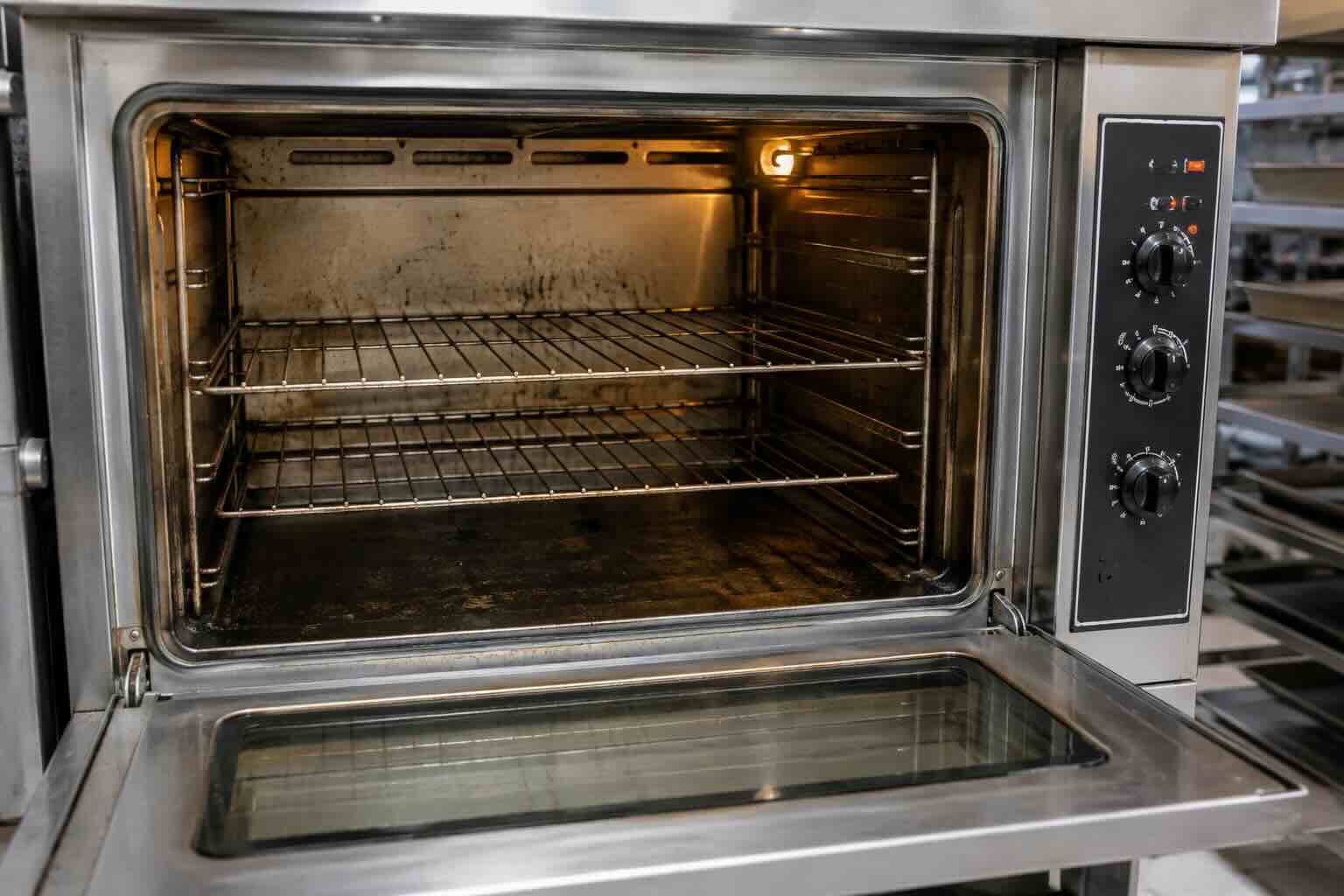
A commercial oven that does not heat evenly can create inconsistent results across the same batch. Food near one side may brown too quickly while items on another rack remain undercooked. Baking times become difficult to predict, staff begin rotating pans manually, and product quality changes from one service period to the next.
Uneven heating does not always mean that the oven has a major mechanical failure. The problem may result from incorrect loading, restricted airflow, insufficient preheating or unsuitable pans. It can also indicate a failing convection fan, inaccurate temperature probe, damaged heating element, burner problem or door-sealing fault.
This guide explains the most common causes of commercial oven hot and cold spots, what kitchen staff can safely inspect and when professional commercial oven repair is required.
WHY IS A COMMERCIAL OVEN NOT HEATING EVENLY?
A commercial oven heats evenly only when several systems work together:
- the burners or heating elements generate the required heat;
- the thermostat or temperature sensor measures chamber temperature accurately;
- the controls cycle the heat correctly;
- the convection fan distributes heated air;
- racks and pans allow air to circulate;
- the doors retain heat;
- staff load and operate the oven according to its design.
A problem in any of these areas can produce uneven browning, inconsistent internal temperatures or longer cooking times.
The first step is determining whether the problem follows a specific location. For example, food may consistently overcook near the rear fan, remain pale near the doors or cook differently on the upper and lower racks. A repeatable pattern provides useful information for diagnosis.
1. THE OVEN WAS NOT FULLY PREHEATED
Loading a commercial oven before it reaches the required temperature can create temporary cold zones and inconsistent results.
The temperature displayed on the control panel does not always mean that every surface inside the oven has stabilized. The air may reach the set temperature before the cavity walls, racks and other internal components have absorbed enough heat.
The problem becomes more noticeable when staff load:
- refrigerated or frozen products;
- multiple cold sheet pans;
- dense products;
- large roasting pans;
- a full oven immediately after startup.
Opening the doors also releases a significant amount of heat. If the oven is loaded slowly or the doors remain open, recovery can take longer.
Blodgett recommends preheating before baking or roasting and notes that product load, pan type and product temperature affect cooking time. Its operating guidance also recommends loading quickly, closing the doors and following the model-specific preheating procedure.
Staff should confirm that the full preheat cycle has completed before evaluating oven performance. If the oven takes unusually long to preheat or repeatedly fails to recover after loading, the heating system should be inspected.
2. TOO MANY RACKS OR PANS ARE RESTRICTING AIRFLOW
Convection ovens depend on moving air. When pans are packed too closely together, heated air cannot circulate evenly around the product.
Common loading problems include:
- using every rack position at once;
- placing deep pans too close together;
- pushing pans against the rear or side walls;
- loading oversized pans;
- placing foil or pans on the oven floor;
- covering ventilation openings;
- overfilling sheet pans.
The result may be dark edges, pale centers, uneven browning or significant differences between rack positions.
Vulcan identifies excessive rack use as a possible cause of uneven browning and recommends using fewer racks to improve circulation. Blodgett warns that placing a pan or aluminum foil on the bottom of a convection oven obstructs airflow and causes uneven baking and roasting.
If the oven performs normally with a small test load but becomes uneven when fully loaded, the issue may involve rack spacing or production procedures rather than a component failure.
3. THE PANS OR PRODUCT LOADS ARE INCONSISTENT
Two pans placed in the same oven may cook differently when they contain different quantities of product or are made from different materials.
Variables that affect results include:
- product weight;
- product starting temperature;
- depth of the food;
- pan color;
- pan thickness;
- pan material;
- pan condition;
- spacing between individual items;
- whether the product is fresh, chilled or frozen.
Dark pans generally absorb heat differently from bright aluminum pans. Warped sheet pans may also hold food at an angle, create uneven product thickness or sit incorrectly on the rack.
Blodgett advises operators to distribute equal amounts of product in each pan because varying quantities can produce uneven baking results. Vulcan also identifies warped sheet pans and racks that are not level as possible causes of inconsistent product movement and baking performance.
Before requesting repair, test the oven with matching pans, equal product quantities and consistent rack positions. This helps separate an equipment problem from a preparation or loading problem.
4. THE CONVECTION FAN IS NOT OPERATING CORRECTLY
The convection fan distributes heated air throughout the cooking chamber. If the fan stops, turns too slowly, operates intermittently or rotates incorrectly, one section of the oven may become hotter than another.
Possible fan-related symptoms include:
- food near the rear browning much faster;
- major differences between left and right sides;
- the oven heating but cooking slowly;
- unusually quiet operation;
- scraping, rattling or grinding sounds;
- airflow that starts and stops unexpectedly;
- a fan that does not operate after the doors close.
The fan may fail because of:
- a worn motor;
- a damaged fan wheel;
- grease accumulation;
- an electrical fault;
- a defective door switch;
- a control-board problem;
- an incorrect fan-delay setting;
- an obstruction around the fan assembly.
Some commercial ovens are designed so that the fan stops when the doors are open. Blodgett lists open doors, incorrect operating mode, a tripped circuit breaker and an active fan-delay feature among possible reasons a convection fan may not run. The manufacturer also specifies that repairs and adjustments involving internal faults should be performed by qualified personnel.
Kitchen staff can listen for normal fan operation and confirm that the doors close fully. Internal fan diagnosis requires professional service.
5. THE THERMOSTAT OR TEMPERATURE SENSOR IS INACCURATE
A commercial oven thermostat controls when the heating system turns on and off. Digital ovens may use one or more temperature probes connected to an electronic controller.
If the thermostat or sensor is out of calibration, the actual chamber temperature may differ from the displayed setting. The oven may run too hot, remain below the selected temperature or cycle across an excessive range.
Typical signs include:
- food consistently finishing earlier or later than expected;
- edges burning while centers remain undercooked;
- large differences between the set temperature and a verified test temperature;
- repeated recipe adjustments;
- long recovery times;
- different results from identical batches;
- temperature-related error codes.
Blodgett identifies thermostat calibration as a possible cause of general baking problems. Vulcan documentation also lists temperature-probe and temperature-control-board failures among faults associated with inaccurate or missing temperature readings.
A single reading from an inexpensive thermometer is not enough to confirm calibration. Commercial ovens normally cycle above and below the setpoint. Proper testing requires multiple readings taken under controlled conditions and interpreted according to the manufacturer’s specifications.
Thermostat or sensor calibration should be completed by a qualified technician. Adjusting the control without proper measurement can make the temperature difference worse.
6. A HEATING ELEMENT HAS FAILED
Electric commercial ovens may use multiple heating elements. Depending on the design, separate elements may supply heat from the top, bottom, rear or around the convection fan.
When one element fails, the oven may still heat, but the remaining elements cannot distribute heat as intended.
Possible indications include:
- the top browns while the bottom remains pale;
- one side of the oven stays cooler;
- preheating takes longer;
- the oven cannot reach its set temperature;
- the heat indicator remains on for unusually long periods;
- visible damage or blistering on an accessible element;
- an electrical or heating error code.
A partially failed electrical connection can create similar symptoms. Testing requires access to energized circuits or internal wiring and should not be attempted by restaurant staff.
Do not assume that a visibly dark element has failed. Some commercial elements do not glow brightly during normal operation, and appearance alone is not a reliable diagnostic method.
7. GAS BURNERS ARE NOT HEATING UNIFORMLY
Gas commercial ovens depend on correct ignition, gas pressure, burner condition and airflow.
Uneven heating may occur when:
- burner ports are clogged;
- the burner is contaminated with grease or debris;
- gas pressure is incorrect;
- the igniter is not operating reliably;
- a gas valve is failing;
- the flame sensor is defective;
- combustion airflow is restricted;
- the burner flame is incomplete or unstable.
The oven may still ignite while producing insufficient or uneven heat.
Warning signs include:
- delayed ignition;
- repeated clicking;
- burners turning off unexpectedly;
- yellow or unstable flames;
- a gas odor;
- soot;
- longer preheating;
- one section of the cavity remaining cooler.
Vulcan lists gas-supply, gas-valve, igniter, flame-sensor and ignition-board problems among possible causes when a commercial oven does not receive a proper heat signal.
Do not clean burner ports with drill bits, adjust gas pressure or dismantle gas valves. If staff smell gas, the oven should not be operated. Follow the facility’s emergency procedure and contact the appropriate gas provider or qualified service professional.
8. THE DOOR IS NOT CLOSING OR SEALING CORRECTLY
A commercial oven door must close evenly and remain sealed during operation. Heat escaping through a damaged gasket or misaligned door can create a cooler area near the front of the cavity and slow temperature recovery.
Possible causes include:
- a torn or hardened door gasket;
- grease or food buildup on the sealing surface;
- worn hinges;
- a damaged latch;
- misaligned dependent doors;
- an obstruction between the door and frame;
- a door switch that does not register closure.
Staff may notice:
- visible gaps around the door;
- more heat escaping from one side;
- longer cooking near the front;
- the convection fan stopping unexpectedly;
- the oven failing to recover after the door is opened;
- damaged or compressed gasket sections.
Vulcan recommends regularly cleaning oven-door gasket surfaces and warns against using sharp instruments or unsuitable solvents that can shorten gasket life.
An accessible gasket can be inspected and cleaned after the oven has cooled. Door alignment, hinge replacement and switch adjustment should be handled by a technician.
9. THE OVEN OR ITS RACKS ARE NOT LEVEL
An unlevel oven can produce uneven food depth, product movement and inconsistent browning. Liquid products may collect on one side of a pan, while dough or batter may bake thicker in one area.
The problem may originate from:
- adjustable legs that have shifted;
- uneven flooring;
- casters that are not seated correctly;
- a stacked oven installed incorrectly;
- bent rack supports;
- racks placed incorrectly;
- warped pans.
Vulcan recommends checking racks from side to side and front to back and identifies an unlevel oven and warped pans as causes of inconsistent product movement.
Staff can check whether the unit rocks and whether racks appear visibly tilted. A stacked or gas-connected oven should not be moved or leveled without following installation and safety requirements.
10. AIR INTAKES OR VENTS ARE RESTRICTED
Commercial ovens require unobstructed airflow not only inside the cooking chamber but also around combustion, motor and control components.
Grease, dust, flour and debris can collect around:
- rear air intakes;
- control-compartment vents;
- cooling-fan openings;
- flues;
- convection fan guards;
- combustion-air openings.
Restricted ventilation may contribute to overheating, unreliable controls and reduced component life. Vulcan instructs operators to keep rear air intakes clear and identifies a clogged rear intake or cooling-fan failure as possible causes of control-board overheating.
Accessible exterior vents can be inspected and cleaned according to the manufacturer’s instructions after the equipment has cooled. Do not spray water or cleaning chemicals into ventilation openings.
11. HEAVY GREASE BUILDUP IS AFFECTING PERFORMANCE
Grease and food residue can accumulate on the fan guard, interior panels, racks and sensing components.
Heavy deposits may:
- restrict airflow;
- insulate temperature sensors;
- interfere with door closure;
- produce smoke;
- create odors;
- affect heat distribution;
- increase fire risk;
- make inspection more difficult.
Cleaning procedures vary between convection, deck, combi, conveyor and pizza ovens. Some components can be removed for cleaning, while others must remain in place.
Use only chemicals and procedures approved for the oven model. Do not spray electrical controls, fan motors, gas components or heating elements with high-pressure water.
HOW TO IDENTIFY THE LOCATION OF A HOT OR COLD SPOT
A consistent cooking pattern can help determine which system requires inspection. Food cooking faster near the rear may indicate strong or poorly distributed convection airflow. Food remaining pale near the doors may point to heat loss, a door-sealing problem or repeated door opening. Products cooking differently between the upper and lower racks may indicate loading problems, failed heating components or unsuitable rack spacing. Uneven results that change from batch to batch may be connected to inconsistent product quantities, pan types, starting temperatures or preheating procedures.
Record:
- selected temperature;
- preheat time;
- rack positions;
- pan type;
- product quantity;
- product starting temperature;
- cooking time;
- location of overcooked and undercooked areas;
- any error codes.
This information gives a technician a more useful starting point than a general report that the oven “is not cooking correctly.”
WHAT KITCHEN STAFF CAN SAFELY CHECK
Staff can complete a limited operational inspection before scheduling service:
- Allow the oven to complete its full preheat cycle.
- Confirm that the correct cooking program and fan setting are selected.
- Verify that the doors close completely.
- Listen for normal convection fan operation.
- Inspect the accessible door gasket for gaps, tears or heavy grease.
- Reduce the number of pans and increase rack spacing.
- Remove foil, pans or other objects from the oven floor unless the manufacturer specifically permits them.
- Use matching, flat sheet pans.
- Distribute equal product quantities across each pan.
- Confirm that air intakes and exterior vents are not blocked.
- Record any error codes.
- Compare results using the same recipe, load and rack arrangement.
If the oven performs evenly with a reduced test load, review the normal loading procedure before assuming that a mechanical repair is necessary.
WHAT YOU SHOULD NOT REPAIR YOURSELF
Restaurant staff should not:
- remove electrical control panels;
- test live voltage;
- replace heating elements;
- adjust thermostats or temperature probes;
- bypass door switches or safety controls;
- adjust gas pressure;
- dismantle burners or gas valves;
- enlarge burner ports;
- override high-limit controls;
- operate the oven with removed fan guards;
- attempt repairs while the oven is hot;
- use open flame to test for a gas leak.
Commercial ovens contain high-voltage circuits, high-temperature surfaces, moving fan components and, in gas models, pressurized fuel systems. Internal diagnosis should be completed by technicians qualified for the specific equipment type.
WHEN UNEVEN HEATING REQUIRES URGENT SERVICE
Schedule professional service promptly when:
- the oven cannot reach the selected temperature;
- temperature differences are becoming more severe;
- the convection fan is not operating;
- the fan produces grinding or scraping sounds;
- one heating element or burner appears inactive;
- the oven displays an error code;
- the doors no longer close correctly;
- staff smell gas;
- ignition is delayed;
- soot or unstable flames are visible;
- the breaker repeatedly trips;
- products cannot be cooked to a consistent internal temperature;
- the problem is disrupting production or forcing menu reductions.
Continuing to use an oven with an electrical, gas or control fault can cause additional component damage and create safety risks.
HOW TO PREVENT COMMERCIAL OVEN HOT AND COLD SPOTS
A preventive maintenance plan should cover both operating procedures and mechanical condition.
Restaurant managers should:
- standardize preheating procedures;
- document approved rack and pan arrangements;
- avoid overloading the cooking chamber;
- use consistent product quantities;
- replace warped pans;
- inspect door gaskets regularly;
- keep air intakes and vents clear;
- clean grease from accessible interior surfaces;
- monitor preheat and recovery times;
- record repeated temperature complaints;
- schedule thermostat and sensor verification;
- inspect fan operation during routine maintenance;
- arrange professional service when small performance changes first appear.
Commercial ovens rarely become severely uneven in a single day. In many cases, staff first notice longer cooking times, minor color differences or a need to rotate pans more frequently. Addressing these early changes can prevent a larger failure during service.
FREQUENTLY ASKED QUESTIONS
Why does my commercial oven cook faster on one side?
One-sided cooking may result from restricted airflow, a fan problem, an uneven load, a failed heating component or a door that does not seal correctly. Test the oven with matching pans and a reduced load. If the same side continues to cook faster, professional diagnosis is recommended.
Why does my commercial oven cook faster on one side?
Routine pan rotation should not be required in a properly operating convection oven when it is loaded according to the manufacturer’s instructions. Some recipes or high-volume loads may still require specific positioning. If staff suddenly need to rotate every batch, inspect the oven for an airflow, temperature or heating-system problem.
How do I know whether the commercial oven thermostat needs calibration?
Possible signs include consistent differences between the selected temperature and actual cooking results, excessive browning, unusually long cooking times and repeated temperature complaints. Calibration cannot be confirmed from one thermometer reading because ovens cycle. A technician should test average temperature performance using the correct procedure.
Can a damaged door gasket cause cold spots?
Yes. A damaged or poorly seated gasket allows heat to escape and can slow recovery, especially near the front of the chamber. Inspect the gasket for tears, hardened sections and visible gaps. Gasket replacement and door alignment should follow the manufacturer’s specifications.
Can a damaged door gasket cause cold spots?
A full load can restrict convection airflow and introduce a large amount of cold product into the chamber. Using too many racks, placing pans too closely together or blocking air passages may produce uneven results. Reduce the load and compare performance before requesting repair.
Can I continue using a commercial oven that heats unevenly?
Minor loading-related variation may be corrected operationally. Do not continue relying on the oven when it cannot produce consistent food temperatures, has a nonworking fan, displays an error, smells of gas or shows signs of an electrical or burner fault. Arrange service before the problem affects food quality or safety.
How much does commercial oven repair cost?
The cost depends on the oven type, fuel source, failed component, required parts and access to the equipment. Fan motors, temperature probes, heating elements, gas valves and control boards involve different repair procedures. An accurate estimate requires diagnosis of the specific oven.
SCHEDULE COMMERCIAL OVEN REPAIR IN NYC
Uneven heating can be caused by an operating issue, but recurring hot and cold spots may also indicate a fan, sensor, heating element, burner, control or door problem.
Screws Appliance Repair services commercial convection ovens, combi ovens, deck ovens, pizza ovens and conveyor ovens used in restaurants, bakeries, hotels and institutional kitchens across New York City. Gas and electric commercial oven diagnostics are available, with same-day dispatch when scheduling permits.
If identical batches are producing different results or your oven no longer maintains consistent heat, schedule a professional inspection before the problem causes further downtime.