A commercial ice machine depends on a controlled flow of water through narrow tubes, valves, pumps, sensors and freezing surfaces. When minerals accumulate inside this system, the machine may continue operating while gradually producing less ice, using more resources and placing additional strain on its components.
Scale buildup in an ice machine usually develops slowly. A restaurant manager may first notice smaller batches, longer production cycles, irregular cubes or a white coating inside the water system. If the deposits are not removed, the machine can eventually stop producing enough ice for normal service.
Mineral scale should not be confused with dirt, mold or slime. It requires a specific descaling procedure, followed by proper cleaning and sanitizing according to the equipment manufacturer’s instructions.
This guide explains how commercial ice machine scale buildup develops, how it affects performance and when professional maintenance is required.
WHAT IS MINERAL SCALE IN A COMMERCIAL ICE MACHINE?
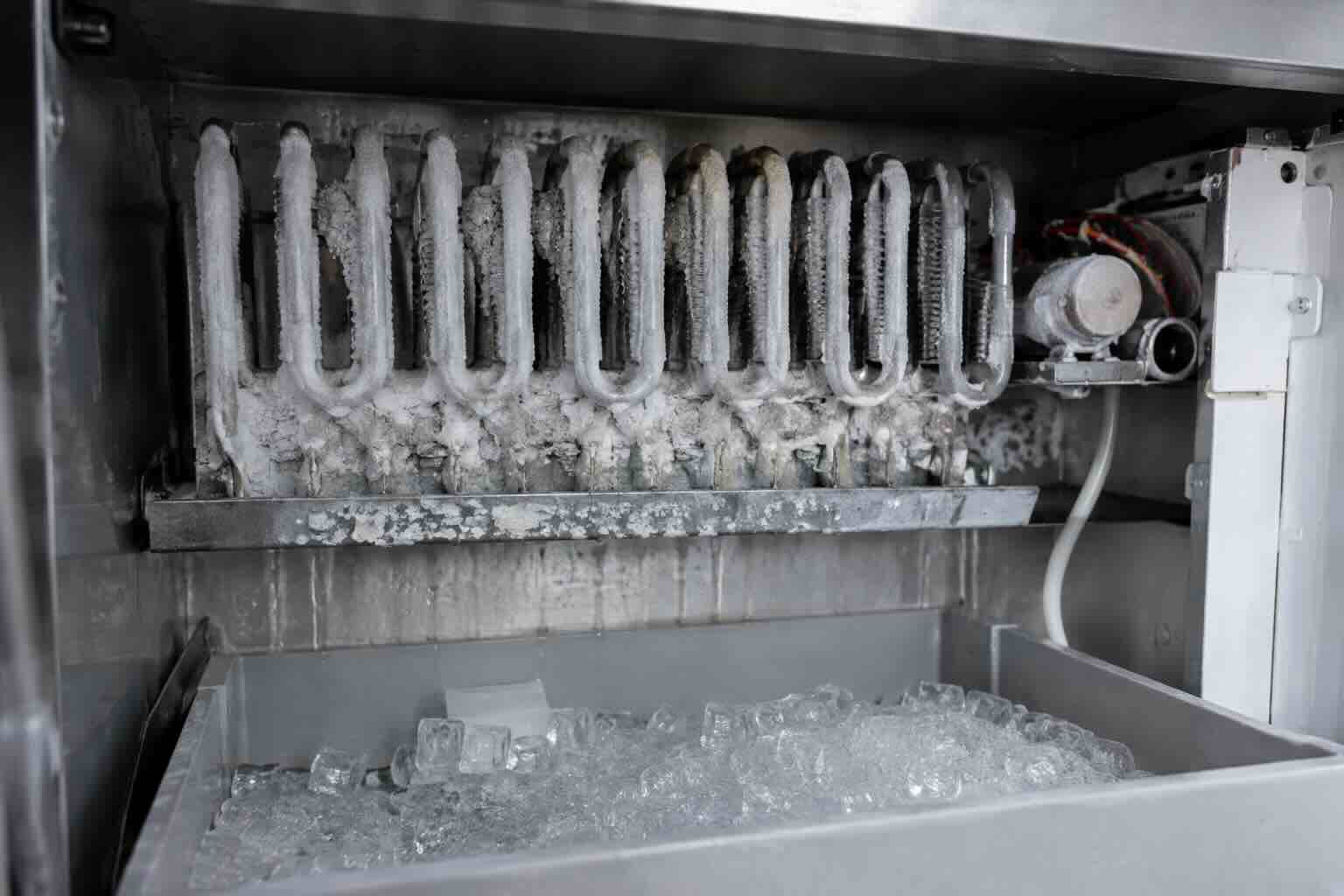
Mineral scale is a hard deposit left behind by dissolved minerals in the incoming water supply. Calcium and magnesium are among the minerals commonly associated with scale formation.
During an ice-making cycle, water flows across or around a freezing surface. Part of that water becomes ice, while some dissolved minerals remain in the liquid water. As the machine repeats this process, the mineral concentration can increase and deposits may begin forming on surfaces that are continuously exposed to water.
Scale can develop on:
- evaporator plates;
- water reservoirs;
- distribution tubes;
- spray nozzles;
- water pumps;
- inlet valves;
- water-level probes;
- ice-thickness sensors;
- augers and freezing cylinders;
- drain and purge components.
The deposits may look white, gray or chalky. In some machines, they form a rough film that is difficult to remove without an approved commercial ice machine descaler.
Scotsman explains that water containing significant mineral quantities can coat the ice machine’s water system and require maintenance more frequently than twice per year. Manitowoc similarly distinguishes descaling, which removes lime and mineral deposits, from sanitizing, which addresses algae and slime.
HOW MINERAL SCALE REDUCES ICE PRODUCTION
One of the most common effects of scale buildup is reduced daily ice production.
A commercial ice machine is designed to freeze and release a specific amount of ice during each cycle. Mineral deposits on the evaporator or other water-contact surfaces can interfere with this process. The machine may need more time to produce each batch, reducing the total amount of ice available during a 24-hour period.
Signs may include:
- the storage bin taking longer to fill;
- insufficient ice during peak service;
- production falling below the machine’s normal capacity;
- unusually long freeze or harvest cycles;
- the machine running more frequently without meeting demand.
Scotsman troubleshooting documentation identifies scale in the water or freezing system as a possible cause when an ice maker operates but produces very little ice. Manufacturer service information also connects scale restrictions in water-cooled systems with low ice production, high operating temperatures and increased water consumption.
Reduced output should not automatically be blamed on scale. High ambient temperature, restricted condenser airflow, low water pressure, refrigeration problems and incorrect equipment sizing can create similar symptoms. A technician should inspect the complete system before determining the cause.
SCALE CAN INTERFERE WITH HEAT TRANSFER
The evaporator is the surface where water freezes into ice. It must transfer heat efficiently and release the finished ice correctly during the harvest cycle.
A mineral coating changes the condition of that surface. Even a relatively thin deposit can prevent water from contacting the evaporator uniformly. Depending on the machine design, this can lead to slower freezing, incomplete cubes or difficulty releasing ice.
As the machine works longer to complete each cycle, operating temperatures and component workload may increase. Pentair’s foodservice water guidance notes that hard scale can increase energy costs and reduce equipment life.
A long production cycle does not prove that the evaporator is scaled. Refrigerant charge, air circulation, condenser condition, water temperature and control settings must also be checked during diagnosis.
ICE CUBES MAY BECOME IRREGULAR
Commercial cube machines rely on an even flow of water and accurate control of ice thickness. Mineral buildup can disturb both.
Depending on the model and location of the deposits, the machine may produce:
- thin cubes;
- incomplete cubes;
- cubes connected by unusually thick bridges;
- irregular cube sizes;
- cloudy or rough-looking ice;
- ice that does not release correctly;
- smaller-than-normal batches.
Scale on an ice-thickness sensor can cause the machine to detect the ice formation incorrectly. Scotsman service documentation states that untreated mineral buildup on an ice-thickness sensor can change bridge thickness.
Ice appearance can also be affected by water chemistry, filtration, freeze-cycle settings and mechanical faults. Descaling should not be treated as a guaranteed correction until the equipment has been inspected.
WATER DISTRIBUTION MAY BECOME RESTRICTED
Water must reach the evaporator evenly. Distribution tubes, spray nozzles and related openings are often relatively narrow, making them vulnerable to mineral accumulation and sediment. When these passages become partially obstructed, some areas of the evaporator may receive less water than others. The machine may then produce incomplete ice, take longer to freeze a batch or allow water to spray or flow in the wrong direction.
Possible symptoms include:
- uneven water flow over the evaporator;
- dry sections on the freezing surface;
- irregular cube formation;
- unusual splashing;
- reduced water circulation;
- water-related error codes.
3M notes that excess particulate can obstruct distribution tubes and that scale-inhibition systems are intended to reduce the harmful effects of scale buildup on ice equipment. Staff should not insert metal tools, wires or drill bits into nozzles and distribution openings. This can enlarge the openings, damage plastic components or push deposits deeper into the system.
SCALE CAN AFFECT SENSORS AND CONTROL COMPONENTS
Modern commercial ice machines use sensors to monitor water level, ice thickness, bin level and cycle operation. Mineral deposits can coat exposed probes and sensing surfaces.
A contaminated sensor may send inaccurate information to the control system. Depending on the model, this may cause:
- incorrect ice thickness;
- premature cycle changes;
- extended freeze cycles;
- delayed harvest cycles;
- intermittent shutdowns;
- service alerts or error codes;
- failure to restart production.
Some sensor surfaces can be cleaned during scheduled maintenance, but the method depends on the manufacturer and component type. Abrasive materials can scratch a sensor or change its operating characteristics.
Scotsman includes removal of dirt and scale from water-level and ice-thickness sensors among its critical service procedures.
FLAKE AND NUGGET MACHINES MAY EXPERIENCE MECHANICAL STRAIN
Flake and nugget ice machines use an auger to move ice through a freezing cylinder. Scale can accumulate on the auger and the internal surface of the evaporator barrel.
Heavy deposits may increase resistance as the auger rotates. The machine may become noisy, production may decline and the auger, bearings, seals or drive components may experience additional mechanical stress.
Warning signs can include:
- grinding or squealing sounds;
- reduced nugget or flake ice production;
- inconsistent ice texture;
- repeated motor overloads;
- the machine stopping during production.
Scotsman service documentation states that scale forms on augers during normal ice production and requires inspection and removal as part of service.
A noisy auger machine should be shut down and inspected rather than repeatedly restarted. Continued operation with mechanical resistance can turn a maintenance issue into a more expensive component failure.
MINERAL BUILDUP CAN INCREASE WATER AND OPERATING COSTS
A scaled machine may need longer cycles to produce the same amount of ice. Depending on its design, it may also purge more water, repeat cycles or run for additional hours to maintain the required bin level.
Scale restrictions in a water-cooled condenser or water-regulating valve can be especially significant. Manitowoc lists low ice production, high water consumption, high operating temperatures and high pressures among symptoms that may occur when these parts require cleaning because of scale buildup.
For a busy restaurant, bar, hotel or café, the business impact can include:
- higher utility costs;
- ice shortages during peak hours;
- emergency ice purchases;
- slower beverage service;
- unplanned service calls;
- additional wear on pumps, motors and refrigeration components;
- complete equipment downtime.
The cost of preventive descaling is normally easier to control than the cost of an emergency breakdown during service.
SCALE REMOVAL AND SANITIZING ARE NOT THE SAME PROCEDURE
Descaling and sanitizing serve different purposes.
Descaling uses an approved acidic solution to dissolve mineral deposits. Sanitizing uses a correctly diluted sanitizing product to reduce microorganisms on food-contact and water-contact surfaces.
Running only a sanitizing cycle will not necessarily remove mineral scale. Similarly, removing visible scale does not mean the machine has been properly sanitized.
Manitowoc explicitly identifies descaler as the product used for lime and mineral deposits and sanitizer as the product used for algae and slime. Its instructions also warn against mixing descaler and sanitizer.
Both procedures must follow the manual for the exact machine model. Chemical type, concentration, circulation time, disassembly requirements and rinsing procedures can differ substantially between manufacturers.
COMMON SIGNS OF SCALE BUILDUP IN AN ICE MACHINE
A commercial ice machine may need inspection and descaling when staff notice:
- white or chalky deposits inside the water system;
- reduced daily ice output;
- longer freeze or harvest cycles;
- thin, incomplete or irregular cubes;
- changes in ice bridge thickness;
- uneven water flow;
- clogged spray nozzles or distribution tubes;
- unusual noise from a flake or nugget machine;
- recurring sensor or water-level errors;
- water overflowing or flowing incorrectly;
- a water filter that is overdue for replacement;
- maintenance records showing no recent descaling.
Some scale may be hidden behind panels or inside internal water components. A machine can therefore have a significant mineral buildup even when the visible storage bin looks clean.
WHAT RESTAURANT STAFF CAN SAFELY CHECK
Before scheduling service, staff can perform a limited visual review:
- Check the last recorded cleaning, descaling and filter-replacement dates.
- Inspect accessible water-contact surfaces for white or chalky deposits.
- Observe whether water flows evenly during normal operation.
- Compare current ice production with the machine’s usual output.
- Inspect the shape and thickness of newly produced ice.
- Record any warning lights or error codes.
- Listen for new grinding, squealing or pump noises.
- Confirm that the water filter is installed correctly and is within its replacement interval.
- Check whether the machine is operating in unusually hot conditions.
- Report the symptoms before the unit stops producing ice completely.
Do not remove electrical panels or reach into a running machine. Ice machines combine water, electricity, moving components and refrigeration equipment, so internal diagnosis should be completed by qualified personnel.
WHAT NOT TO USE FOR COMMERCIAL ICE MACHINE DESCALING
Do not assume that vinegar, bleach or a general kitchen cleaner is safe for every commercial ice machine.
Only use a descaler approved for the particular manufacturer and model. An incorrect chemical or concentration may damage:
- nickel-plated evaporators;
- stainless-steel components;
- seals and gaskets;
- pumps;
- plastic parts;
- sensors;
- water lines.
Do not:
- mix descaler with sanitizer;
- mix acidic products with chlorine bleach;
- use a wire brush on water-system components;
- scrape the evaporator with a metal tool;
- chip deposits away with a knife or screwdriver;
- run cleaning chemicals through the machine without following the manual;
- serve ice produced during a cleaning or descaling procedure.
Manitowoc instructs operators to use approved products, avoid mixing cleaning and sanitizing solutions and discard ice associated with the maintenance procedure. Scotsman also warns that commercial scale removers contain acids and must be handled carefully.
HOW OFTEN SHOULD A COMMERCIAL ICE MACHINE BE DESCALED?
There is no universal schedule that applies to every machine and water supply.
Many manufacturers specify descaling and sanitizing at least every six months. More frequent maintenance may be necessary when the incoming water contains a high mineral concentration or when deposits develop rapidly.
Scotsman recommends removing scale from the water system and changing filters at least every six months, with more frequent maintenance at sites where the water contains significant mineral quantities. Manitowoc also specifies six-month descaling intervals for many models and advises consulting a qualified service company when more frequent cleaning is necessary.
The appropriate schedule depends on:
- the machine model;
- daily ice production;
- local water conditions;
- filtration or treatment system;
- equipment age;
- operating environment;
- manufacturer requirements;
- previous scale accumulation.
Maintenance records should include the date, work performed, chemicals used, filter replacement and any parts that showed heavy deposits.
CAN A WATER FILTER PREVENT ICE MACHINE SCALE?
The correct water-treatment system can reduce scale formation, but not every filter provides the same protection.
Basic sediment filtration can remove particles but may not address dissolved hardness minerals. Ice machine filtration systems with dedicated scale-inhibition media are designed to reduce the ability of minerals to attach to internal surfaces.
Hoshizaki states that its applicable ice-machine filtration system reduces sediment and lime-scale buildup, helping protect equipment and reduce maintenance. Replacement intervals depend on usage and water conditions. 3M also offers foodservice filtration systems with integrated scale inhibition for commercial ice machines.
A filtration system must be:
- suitable for the ice machine type;
- sized for the required flow rate and production capacity;
- compatible with the local water conditions;
- installed according to the manufacturer’s requirements;
- replaced at the correct interval.
Severe water conditions may require testing and a treatment system selected specifically for the property. Installing a generic cartridge without reviewing water chemistry and equipment requirements may not solve recurring scale problems.
WHEN PROFESSIONAL ICE MACHINE SERVICE IS REQUIRED
Schedule professional service when:
- production has fallen significantly;
- scale returns soon after cleaning;
- the machine repeatedly shuts down;
- cubes are consistently incomplete or irregular;
- an auger machine produces grinding or squealing sounds;
- the evaporator is heavily coated;
- water no longer flows evenly;
- sensors show recurring errors;
- internal components require disassembly;
- the correct cleaning procedure is unknown;
- the machine has not been serviced for an extended period.
A technician can inspect the water circuit, evaporator, sensors, pumps, valves, refrigeration system and filtration setup. This is important because low ice production may be caused by scale, but it can also indicate a condenser, water-supply, control or refrigeration fault.
FREQUENTLY ASKED QUESTIONS
Can mineral scale cause a commercial ice machine to stop making ice?
Yes. Heavy scale can restrict water circulation, interfere with sensors, affect the evaporator and prevent the machine from completing its normal freeze or harvest cycles. However, no ice production can also result from water-supply, refrigeration, electrical or control failures, so professional diagnosis may be required.
Does white buildup inside an ice machine mean mold?
Not necessarily. White or chalky deposits are commonly associated with minerals in the water. Mold, slime and biofilm may have different colors and textures. Descaling and sanitizing are separate procedures, so the machine may require both.
Can I descale a commercial ice machine with vinegar?
Only when the manual for the exact model specifically permits it. Many commercial machines require a manufacturer-approved descaler at a defined concentration. Using an unapproved acidic product may damage the evaporator and other components.
How long does commercial ice machine descaling take?
The required time depends on the model, amount of scale and level of disassembly. A routine automated cycle may take less time than a detailed procedure involving removal and soaking of components. Heavily scaled machines may require additional treatment and inspection.
Will replacing the water filter remove existing scale?
No. A new filter may help reduce future accumulation if it includes appropriate scale-control technology, but it will not remove mineral deposits already attached to the evaporator, reservoir, sensors or water lines. Existing buildup requires proper descaling.
Why does scale return quickly after cleaning?
Recurring scale may indicate high mineral content in the incoming water, an unsuitable filter, an exhausted cartridge, incorrect purge operation or an inadequate maintenance schedule. Water testing and a review of the filtration system may be necessary.
SCHEDULE COMMERCIAL ICE MACHINE SERVICE IN NYC
Mineral buildup can reduce ice output, interfere with sensors, restrict water flow and increase strain on critical components. Waiting until the machine stops completely can leave a restaurant, bar, café or hotel without enough ice during operating hours.
Screws Appliance Repair provides commercial ice machine diagnostics and repair across New York City. The company services modular cube machines, undercounter units, flake and nugget machines, dispensers and remote-condenser systems, including equipment with low production, water-flow problems, clogged filters, sensor faults and other performance issues.
If scale is visible or the machine is producing less ice than normal, schedule an inspection before the buildup causes further downtime.