
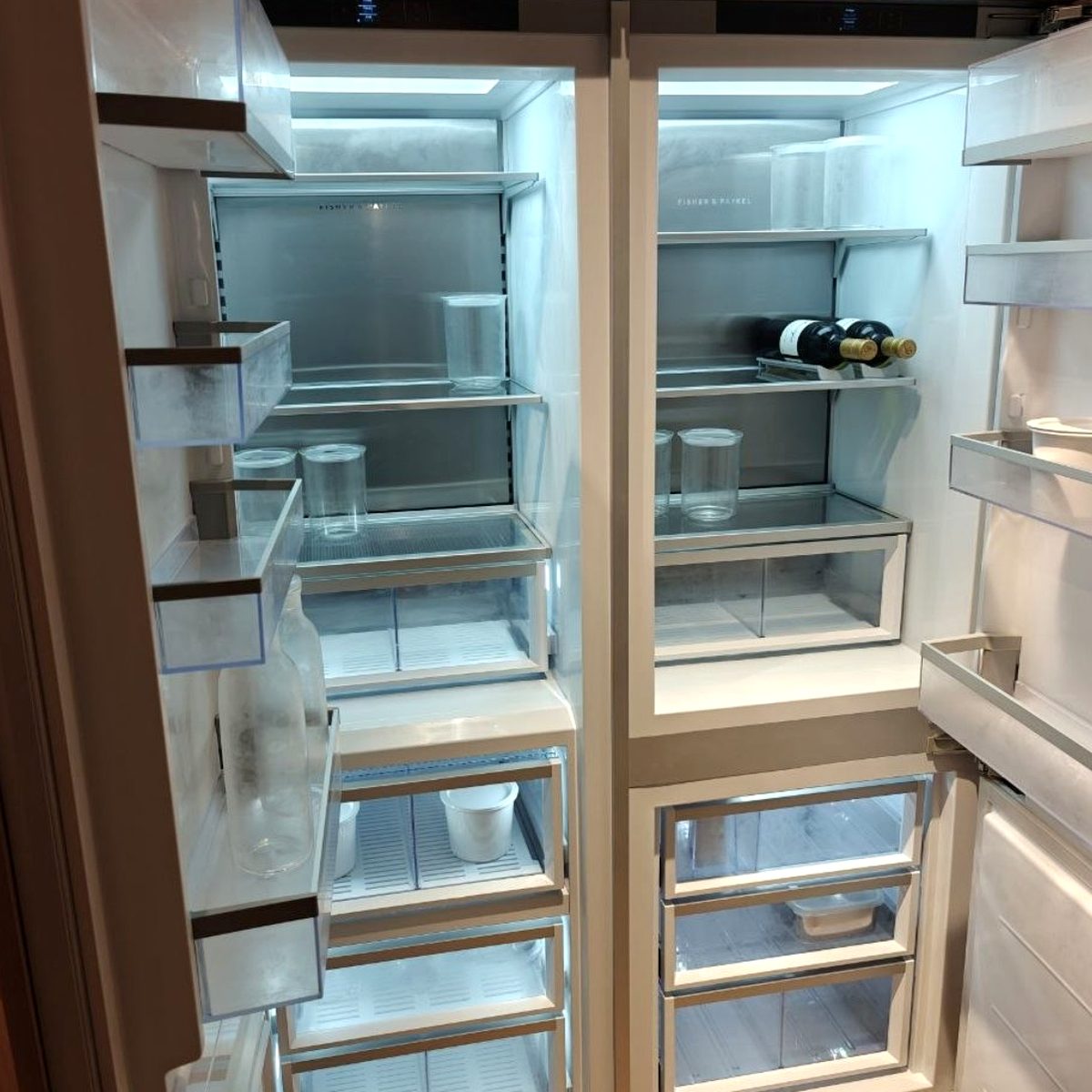
A refrigerator that is not cooling may have blocked vents, a door that will not seal, incorrect settings, or restricted condenser airflow. A failed fan, defrost component, compressor, or temperature control can cause similar symptoms. The first steps are to protect your food, measure the temperature, and check the items you can reach safely—not to order parts based on a noise or an error code.
This guide is for residential refrigerators in Boston homes, condos, and apartments. It explains ten possible causes, basic checks, and what to prepare before requesting repair. Always use the instructions for your exact model; different refrigerators do not share the same cooling layout or reset procedure.
Protect Your Food Before Troubleshooting
Use an appliance thermometer rather than relying only on the display, which may show a selected setting rather than the actual temperature. USDA guidance recommends a refrigerator temperature of 40°F (about 4°C) or below and a freezer temperature of 0°F (about -18°C) or below.
Move at-risk perishables to a working refrigerator or an ice-filled cooler that maintains safe temperatures. FDA guidance says to discard perishable food such as meat, poultry, fish, eggs, and leftovers that has been above 40°F for two hours or more. Do not taste food to test its safety or rely on smell alone. Use the FoodSafety.gov chart for item-specific decisions.
During a power outage, an initially cold refrigerator can keep food cold for about four hours if its doors remain closed. That is not permission to leave already-warm perishables above 40°F for four hours. If you do not know how long food has been warm, do not assume that cooling it again makes it safe.
Safe Checks to Do First
Start with observations that do not involve removing panels or moving a heavy appliance.
- Check power safely: look at the lights and display, and check whether the home has power. Inspect the plug only if it is accessible and the area is dry. A working light does not prove that the cooling system is operating. Do not repeatedly reset a tripping breaker or GFCI.
- Check settings: confirm that cooling is enabled and use the model’s recommended refrigerator and freezer settings. Photograph any error or unusual mode before changing it.
- Check doors and vents: move packages that obstruct closure or cover vents. Wipe accessible door seals and check for damage.
- Record what you notice: note temperatures in both compartments, frost location, leaks, and new sounds. These are clues, not a component diagnosis.
If there is smoke, sparking, a burning smell, or water near electrical connections, stop troubleshooting. Do not touch a wet outlet or cord. Seek appropriate emergency help for an active fire or electrical danger.
10 Possible Reasons a Refrigerator Stops Cooling
The following causes overlap. A technician may need to test several systems before identifying the fault.
1. Blocked Airflow Inside the Cabinet
Food containers pushed against vents can restrict cold-air circulation. On many single-evaporator refrigerator-freezers, this can leave the fresh-food compartment warm while the freezer remains colder. Other designs have separate cooling systems, so a cold freezer does not rule out a refrigerator-side fault.
Move items away from visible supply and return vents and leave space for circulation. Do not remove internal covers. After correcting the loading, monitor the temperature instead of assuming the problem is solved because air feels cooler.
2. A Door That Does Not Seal Properly
A trapped bag, incorrectly installed drawer, dirty gasket, or misaligned door can let warm air enter. Check the full seal and remove obvious obstructions. On French-door units, check whether the center flap closes correctly, without forcing it.
A split seal or sagging door needs further attention. Follow the owner’s manual for any permitted adjustment; do not loosen heavy door hinges or remove decorative panels simply to test a theory.
3. Dust or Restricted Ventilation Around the Condenser
The condenser releases heat removed from the cabinet. Dust and debris can reduce performance on designs with exposed coils. However, some refrigerators have condensers that do not need routine homeowner cleaning or that require professional access.
Consult the manual before cleaning. Unplug the refrigerator or disconnect power as instructed before cleaning an accessible condenser area. Use only the permitted brush or vacuum method. Do not remove electrical covers, bend tubing, or pull out a built-in appliance. Keep ventilation grilles clear and follow the model’s installation clearances rather than a universal spacing rule.
4. Incorrect Settings or a Cooling-Off Mode
A temperature setting may have been changed accidentally. Some models also have a showroom, demo, or Cooling Off mode that disables cooling while lights and parts of the display continue to work. Samsung documents this behavior on specific refrigerator models.
Do not assume that every Energy Saver, Vacation, or Holiday setting turns refrigeration off; those functions vary by model. Look up the displayed mode in the manual and follow that model’s exit procedure. Avoid trying unrelated button combinations found online.
A settings correction needs time to take effect, but protect food elsewhere while you monitor recovery.
5. Recent Installation, Transport, or a Power Outage
A newly installed refrigerator may need up to 24 hours to stabilize, depending on the model and conditions. Follow the manufacturer’s instructions and confirm safe temperatures before loading perishables. This startup period is different from a refrigerator that suddenly becomes warm after working normally.
After transport, follow the specified upright waiting period before switching the appliance on. GE’s instructions vary with the model and how it was transported; there is no single waiting time for every refrigerator. A power outage alone does not mean the appliance needs to be left upright to “settle.”
If cooling does not recover as the manual describes, or food is warming, arrange service rather than repeatedly restarting the unit.
6. Defrost Problems or Ice Blocking Airflow
Heavy ice behind the freezer’s interior cover can obstruct circulation. A defrost heater, sensor, control, or wiring fault may be involved. However, frost can also develop when moist air enters through an open or poorly sealed door; frost alone does not identify the failed component.
Photograph the frost pattern before any approved defrosting. Do not chip ice with a knife or screwdriver, and do not use a hair dryer or heat gun. Temporarily restoring airflow by melting ice does not establish why it formed or repair a failed component. Recurring ice and warming need diagnosis.
7. An Evaporator Fan Problem
An evaporator fan circulates cold air on models that use one. A failed motor, ice obstruction, wiring issue, or missing control signal can reduce airflow. Refrigerators with separate evaporators may have a fan for each compartment.
Weak airflow, scraping sounds, or a warm refrigerator with a colder freezer can help narrow the investigation, but silence alone does not prove fan failure. Do not bypass a door switch, reach into a fan opening, or remove the evaporator cover. The fan and its controls require model-specific testing.
8. A Condenser Fan Problem
On refrigerators fitted with a condenser fan, that fan helps remove heat from the condenser and compressor area. Poor airflow can contribute to weak cooling and overheating. A blocked grille or dirty condenser can produce similar symptoms.
A warm exterior surface or an unfamiliar noise is not enough to diagnose the fan. Record the symptoms and leave rear-panel removal and electrical testing to a technician. Not every refrigerator uses the same condenser or fan arrangement.
9. Compressor, Starting-Component, or Sealed-System Problems
Repeated clicking combined with loss of cooling can involve starting components, power supply, controls, or the compressor. Poor cooling can also involve a refrigerant-system problem. Do not assume a clicking sound means that replacing a relay will solve it.
Nor does long running automatically mean a compressor has failed. Frigidaire notes that some variable-speed models are designed to run for extended periods or continuously outside defrost. What matters is whether the appliance maintains the required temperature.
Compressor and sealed-system diagnosis are not homeowner tasks. Do not install refrigerant-piercing valves or attempt a “top-up.”
10. Temperature Sensor, Thermostat, or Control Faults
An inaccurate sensor, faulty thermostat, wiring issue, or control-board problem can prevent correct cooling. Similar symptoms can arise from airflow or refrigeration faults, so a warm cabinet or error code alone is not a reason to replace the board.
Photograph the code and write down actual temperatures in both compartments. Use only a manufacturer-approved reset when appropriate. A temporary improvement after a restart does not establish that the control board was the cause.
What to Record Before Calling for Service
Send the brand, model and serial number, temperatures in both compartments, when the problem began, any recent move or outage, and what you already checked. Include photos of the display, data label, visible frost, and the appliance’s installation. A brief recording of an unusual sound may also help.
For a Boston apartment or condo visit, tell the service team about relevant access arrangements: stairs or elevator access, parking or loading restrictions, a required building appointment, and built-in cabinetry. Do not pull out an integrated refrigerator to prepare for the visit. If the appliance belongs to your landlord, notify the landlord or property manager before authorizing repairs.
When to Stop Storing Food—and When to Shut the Unit Down
Stop relying on the refrigerator for perishables when it cannot maintain safe storage temperatures. Transfer food promptly and make food-safety decisions using its time and temperature history, not just the present display.
Stop operating the appliance and seek help for a burning smell, sparks, repeated breaker trips, serious mechanical distress, or water reaching electrical parts. Disconnect power only when it is safe to do so. A cooling fault without an electrical hazard still needs attention, but it is not automatically an instruction to unplug the machine before speaking with the service team.
Persistent temperature problems, recurring frost, repeated error codes, and clicking without cooling warrant a repair appointment. A leak also needs investigation, but not every leak means the defrost system or compressor has failed.
Preventive Habits That Help
Keep interior vents clear, close doors promptly, wipe seals, and check your appliance thermometer regularly. Avoid covering exterior grilles with stored items. Follow the owner’s manual for condenser cleaning and clearance requirements rather than cleaning every model on the same fixed schedule.
After a move, follow the transport and startup instructions. After an outage, check settings and temperature recovery; do not confuse a transport settling period with an ordinary power interruption.
Frequently Asked Questions
Why is the refrigerator warm while the freezer is still cold?
Blocked airflow, ice, a fan fault, or a temperature-control problem may be involved. Separate-cooling designs can also have a fault affecting only the refrigerator section. Measure both compartments and provide the model number; a frozen item is not a complete cooling-system test.
Why is the refrigerator running constantly but not getting cold?
Possible causes include a door leak, poor airflow, a dirty condenser, or an internal fault. Long running alone can be normal on variable-speed models. Long running combined with unsafe temperatures needs investigation.
Can I fix a refrigerator that is not cooling myself?
You can check accessible settings, clear vents, remove door obstructions, and perform cleaning permitted by the manual. Disconnect power before approved condenser cleaning. Leave electrical testing, internal fan work, and sealed-system repairs to qualified technicians.
Why did cooling stop after a power outage?
The appliance may need its cooling function re-enabled or time to resume normal operation; a component fault is also possible. Follow the model’s instructions. An outage does not, by itself, prove that a control board or compressor was damaged. Protect your food while checking recovery.
How long should I wait after plugging the refrigerator in?
Check the model’s instructions. A new installation or major adjustment can require up to 24 hours to stabilize. Do not use that window as a reason to leave perishables in a warm refrigerator or delay reporting a sudden loss of cooling.
Why is it leaking water and not cooling at the same time?
Melting ice or a restricted defrost drain may explain water, but a supply-line leak or another separate issue may also be present. Note where the water appears. The two symptoms may be connected, but they do not prove that one particular component has failed.
How much does refrigerator repair cost in Boston?
The price depends on the model, diagnosis, parts, labor, and access. A built-in unit can require different work from a freestanding top-freezer refrigerator. Request a diagnostic assessment and a repair estimate rather than treating a symptom-based price online as a confirmed quote.
Refrigerator Repair in Boston
Screws Appliance Repair services residential refrigerators in Boston homes and apartments, including built-in, French-door, side-by-side, top-freezer, and bottom-freezer models.
If basic checks do not restore cooling, visit our refrigerator repair in Boston service page to request diagnostics. Include the model number, temperatures, error messages, and any access restrictions so the team can prepare for the appointment.
Keep food in verified safe storage while waiting for service. Do not repeatedly change settings or clear a returning fault instead of arranging a diagnosis.